
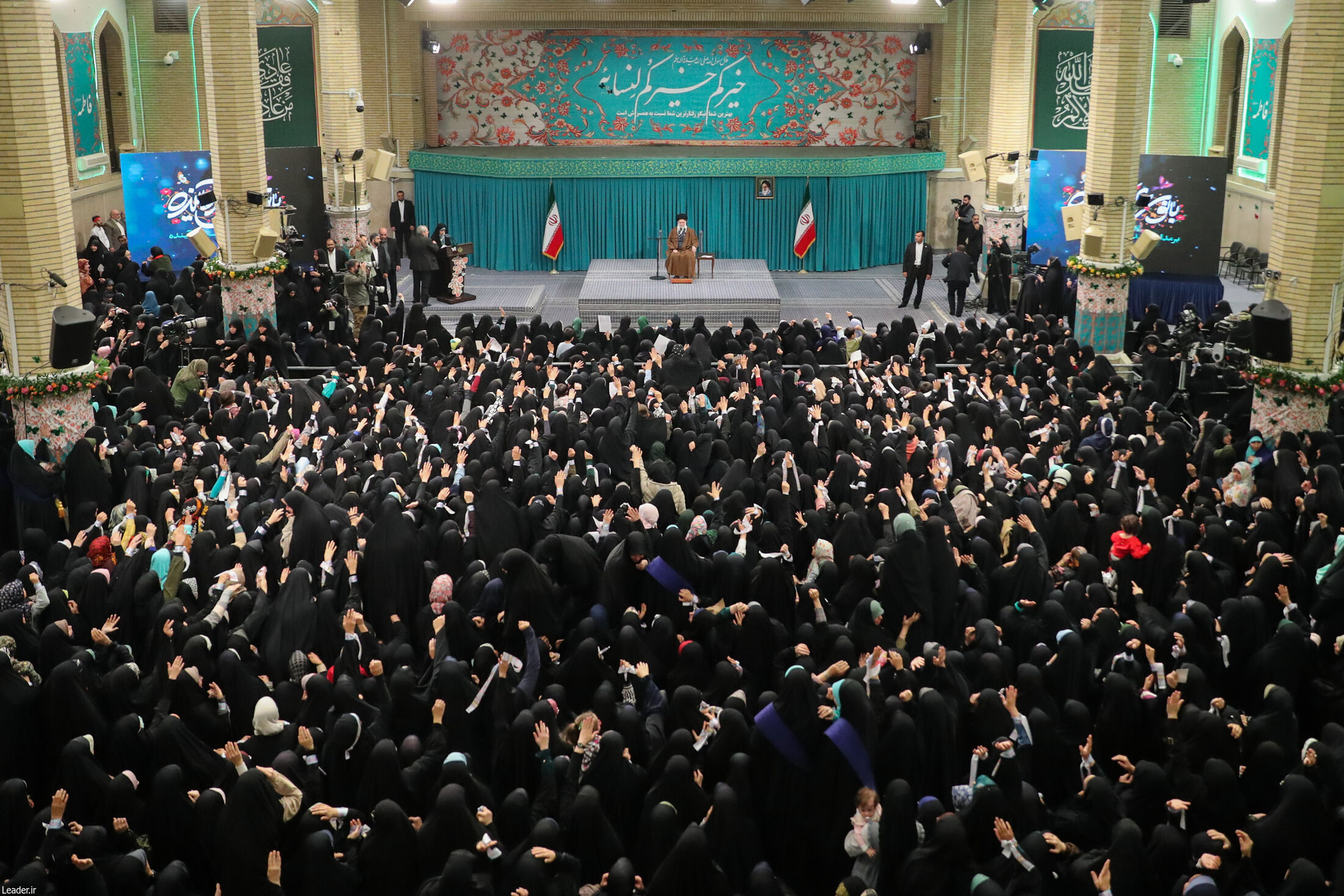
This morning, the Leader of the Islamic Revolution met thousands of women and girls from across the country. He described Lady Fatima al-Zahra (s.a.) as a celestial human adorned with the highest of virtues. He elaborated on Islam’s perspective regarding the status and rights of women both at home and in society and explained the duties and prohibitions governing men’s behaviour toward their wives and women in various areas.
Ayatollah Khamenei pointed to the boundless virtues of the Lady of the Worlds, mentioning her worship and humility, her self-sacrifice and generosity toward people, her courageous defence of the rights of the oppressed, how she enlightened others and explained truths, her political insight and action, her management of the household, being a devoted wife and a nurturing mother, and her participation in pivotal and other events in early Islamic history. He said, “Thanks be to God, the Iranian woman takes this radiant sun as her model and guide whom the Prophet (s) called the chief of all women of every age, and moves in the direction of her objectives.”
He described women’s status in Islam as exalted and sublime, adding, “Quranic expressions regarding the identity and personality of women are the most sublime and progressive of all.”
The Leader referenced the verses of the Holy Quran that illustrated “the equal role of women and men in the life and history of humankind, and the equal possibility for women and men to grow and reach spiritual perfection and the highest stations.” He said, “All of these points stand in clear contradiction to the misunderstandings of those who are religious yet have not truly understood religion as well as those who do not accept religion at all.”
He then elaborated on the Qur’an’s logic regarding women’s rights in society. He pointed out, “In Islam, women have equal rights with men in social activity, business, political engagement, in most governmental posts, and in a variety of other fields. And in spiritual journeying, the path is completely open for them along with the effort necessary for personal and collective advancement.”
Ayatollah Khamenei noted that the decadent Western and capitalist culture is totally rejected in Islam. He said, “In Islam, in order to preserve the dignity of women and to restrain the very powerful and potentially dangerous sexual impulses, certain limitations and rulings exist regarding the interaction between women and men; the dress code for men and women, the hijab for women, and the encouragement of marriage. These rulings are fully in harmony with women’s nature and the true interests and needs of society. In contrast, controlling the boundless and destructive sexual impulses is entirely neglected in Western culture.”
The Leader said that men and women in Islam were two balanced elements with many commonalities and some differences arising from their physical and natural makeup. He said, “These two complementary elements play essential roles in managing human society, continuing the human race, advancing civilisation, meeting societal needs, and running the affairs of life.”
In this vital role-playing process, he called the founding of a family the most important act, noting that, “Contrary to the neglect of the family institution in misguided Western culture, Islam has specified mutual and clear rights for women, men, and children as the constituent elements that form a family.”
Continuing his remarks on women’s rights, the Leader identified justice in social and family life as the primary right of women. Emphasising the duty of the government and all members of society in securing this right, he stated, "Safeguarding security, sanctity, and dignity are also among women’s fundamental rights. Contrary to Western capitalism, which tramples upon the dignity of women, Islam emphasises complete respect for women.”
Referring to a saying of the Prophet Muhammad (s) that describes woman as a flower and not an agent for household chores, he added, “From this point of view, one must avoid reproach and harshness toward women, and instead care for and protect them like a flower, so that they may also fill the home with their colour and fragrance.”
Ayatollah Khamenei cited the Quran’s mention of two faithful women, Mary and Asiya (the wife of Pharaoh), as benchmarks for all believing men and women, demonstrating the importance of women’s thought and action. He said, “Women’s social rights, such as equal pay for equal work, insurance for working women or female heads of households, special leave for women, and dozens of other issues, must be observed and upheld without discrimination.”
He identified the husband’s affection as the most important right and need of a woman within the home. Citing a narration that advises men to express love and affection openly to their wives, he added, “Another significant and crucial right of women in the home is the rejection of any form of violence against them and the complete avoidance of the deviations prevalent in the West, such as men or husbands killing or beating women.”
The Leader of the Revolution stated that among other rights of women are: refraining from imposing household work on women; the right of having husbands assist wives in dealing with the effects of childbirth; and making the path for their scientific and professional advancement available. Emphasising that women are the managers and heads of households, he said, “We must appreciate women who, despite their husbands' insufficient and fixed incomes and the high cost of goods, skilfully manage the household.”
In describing the confrontation between the capitalist and Islamic perspectives on women, he said, “In Islam, women have independence, ability, identity, and the possibility for advancement. However, the capitalist perspective entails the subordination and dissolution of a woman’s identity into that of the man, disregarding her honour and dignity. It treats women as material objects and a tool for lust and entertainment; an approach whose consequences are evident in the criminal gangs that have recently caused great uproar in the United States.”
Ayatollah Khamenei said that the destruction of the family structure and the creation of social evils such as children without recognised fathers, the weakening of family lineage, gangs that prey upon young girls, and the increasing promotion of sexual promiscuity under the name of freedom are some of the great sins of capitalist culture in the past one or two centuries. He said, “Western capitalism deceitfully labels this vast array of wrongful acts as ‘freedom,’ and even in our country, they use this term to promote it. However, this is not freedom but slavery.”
Referring to the West’s insistence on exporting its corrupt culture to the world, he said, “They claim that certain limitations for women, such as the ḥijāb, will hinder their progress. However, the Islamic Republic has invalidated this flawed logic and demonstrated that a Muslim woman adhering to the Islamic dress code can advance and play a greater role than others in all fields.”
The Leader catalogued women’s accomplishments in the fields of science, athletics, intellectual pursuits, research, political, social, and health-related achievements, as well as their increased life expectancy, their jihād-like support activities, and the empowering companionship of the wives of the honourable martyrs as unprecedented in the history of Iran. He said, “At no point in its history has Iran possessed even one-hundredth of this number of female scientists, thinkers and intellectuals. It was the Islamic Republic that elevated women and enabled their advancement in all fields of importance.”
Making an important recommendation, the Leader warned the media against the erroneous Western capitalist view of women. He said, “Whenever hijab, women’s dress, or male–female cooperation are discussed, domestic media must not echo and amplify Western talking points. Instead, Islam's profound and effective perspective should be presented and amplified both domestically and in international forums because this is the best method of presenting Islam, and it will draw many people around the world, especially women, toward it.”
Prior to the Leader's speech, the wife of Martyr General Gholām ‘Alī Rashīd and the mother of Martyr Amīn ‘Abbās Rashīd, as well as the daughter of Martyr General Ḥusayn Salāmī, presented remarks regarding women, their responsibilities, and their needs.