
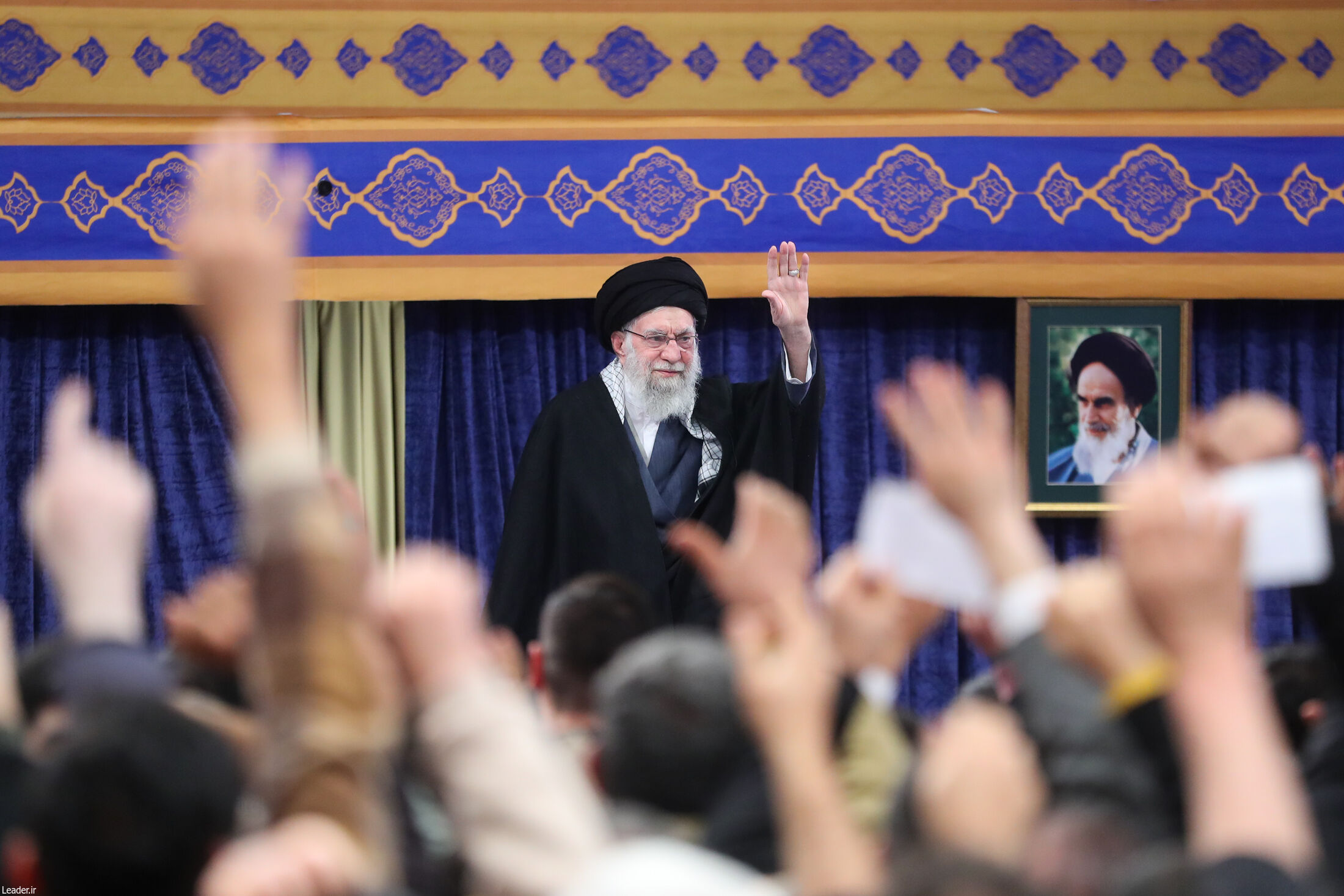
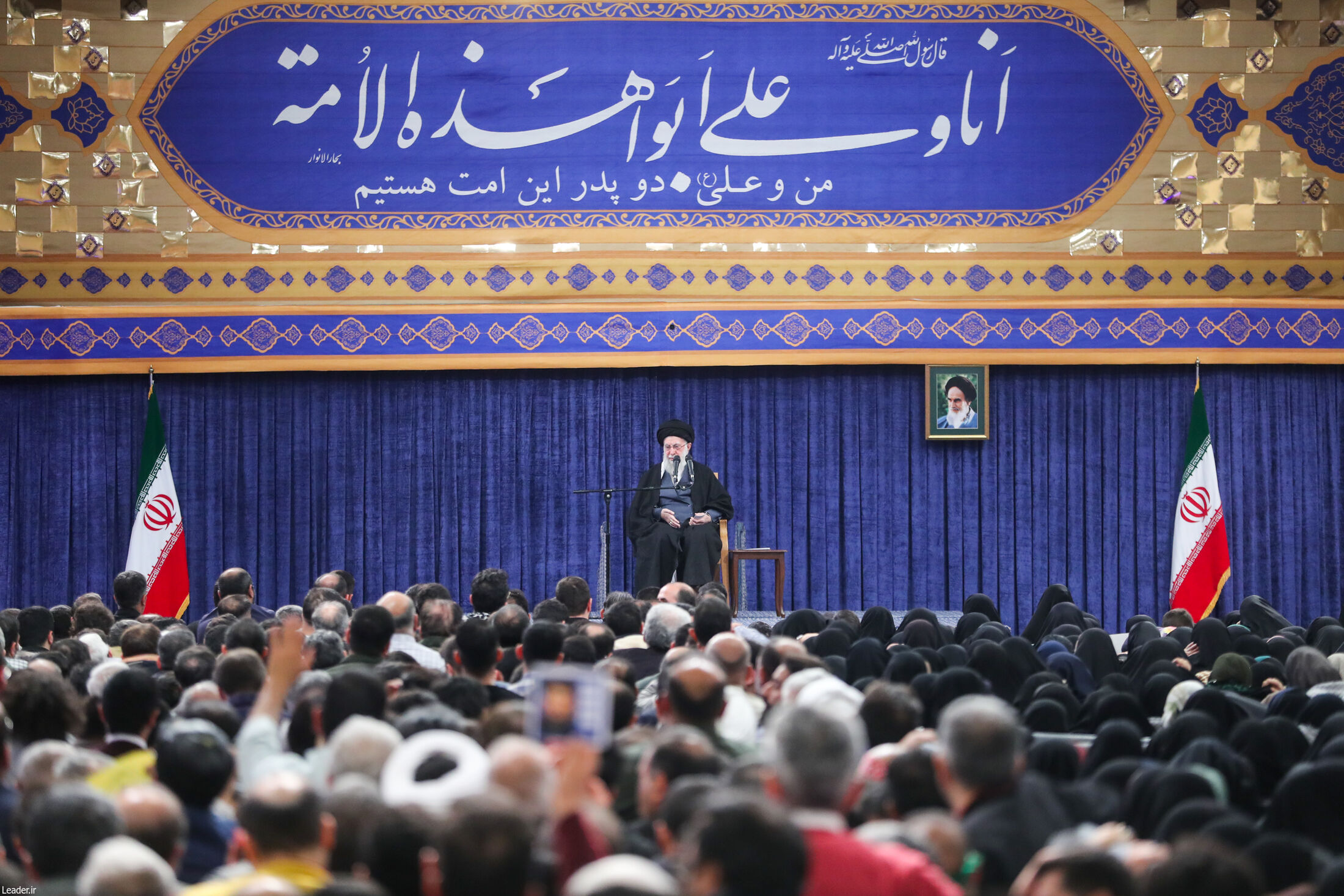
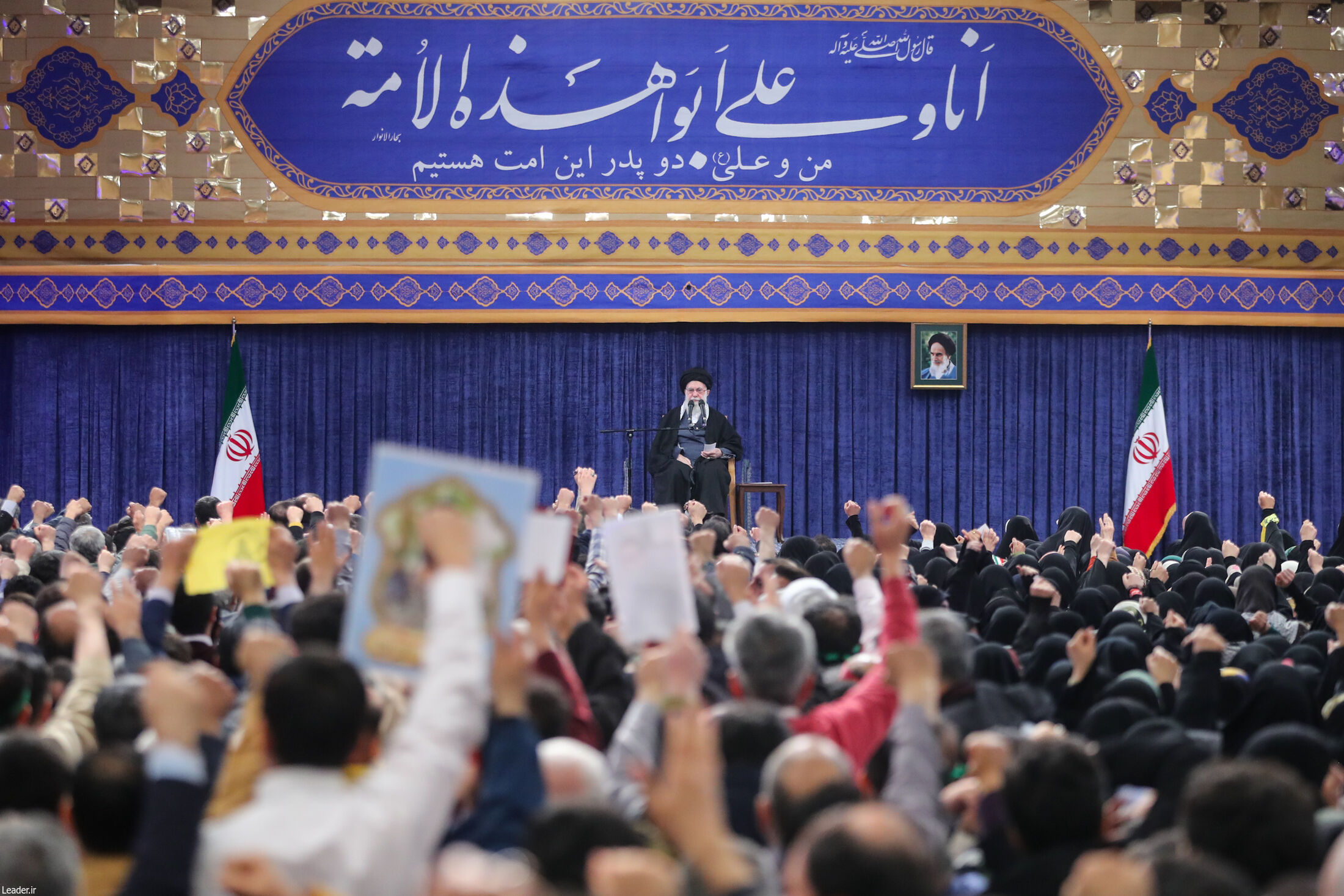
On the auspicious anniversary of the birth of the Commander of the Faithful, Imam Ali ibn Abi Talib (as), and the sixth anniversary of the martyrdom of General Soleimani, the Leader of the Islamic Revolution met with the esteemed families of the martyrs of the Twelve-Day War (the Martyrs of Dignity). He described the justice and God-consciousness of the Commander of the Faithful as two essential summits the country requires and are the most indispensable qualities for governing society. He emphasised the need for vigilance and the strengthening of national unity in the face of the enemy’s ‘soft war.’ He said, “This war, based on deception, lies, slander, and rumours, is the very same war the enemies of the Alawi government launched after suffering military defeats at his (Imam Ali’s) hands in order to prevent the realisation of his objectives.”
Ayatollah Ali Khamenei described the anniversary of the birth of the Commander of the Faithful, Ali ibn Abi Talib(as), as an exceptional day in history, both in terms of the place of his birth, the House of God, and the person who was born. He said, “Among his matchless qualities, today we have a more urgent need for two of them in particular: justice and God-wariness. We must take the Commander of the Faithful as our model; we must move toward these two summits upon which Imam Ali (as) stood. Of course, we have made some progress on this path, but we are still far from reaching where we ought to be.” Explaining the various methods that Imam Ali ibn Abi Talib(as) employed to realise justice, the Leader of the Islamic Revolution said, “Sometimes he applied justice through kindness, serving the weak, and supporting fatherless families; at other times through Dhu’l-Fiqar with divine severity; and at yet other times through eloquent speech, wisdom, and wise clarification.”
He described the Commander of the Faithful, Ali ibn Abi Talib(as), as the fountainhead of the jihad of clarification and added, “His governmental decree to Malik al-Ashtar is replete with concepts that actualise justice.”
Ayatollah Khamenei explained Imam Ali’s (as) methods with regard to God-wariness, He said, “Sometimes the Commander of the Faithful manifested taqaā (God-wariness) in the prayer niche through worship, prayer, and humble supplication before the Lord. This left the angels of the Throne in awe and admiration. At other times, he embodied it through patience, silence, and forgoing his own rights to preserve Muslim unity and prevent discord among them. And at yet other times, he demonstrated it through stepping forward in the most difficult situations, such as the Night of the Abode (Laylat al-Mabit) and the campaigns of the Prophet Muhammad (s).
He emphasised the need for every sector of society, especially officials, to follow the God-wary methods of the Commander of the Faithful (as), adding, “Alawi justice is also the most urgent and vital need of the country. Unlike Shiʿa communities throughout much of history, we have no excuse for failing to pursue or implement justice, for the system of governance is the Islamic Republic of Iran which is an Alawi system of governance.”
The Leader of the Islamic Revolution listed some obstacles to achieving justice and God-wariness. He said, “Sometimes fear, sometimes hesitation, sometimes considerations of personal ties, and sometimes even concern about the enemy obstructing progress; but we must move toward expanding justice and God-wariness without undue reservations.” Drawing the attention of the nation and officials to an important point in Commander of the Faithful’s life, he said, “It must be noted that the Commander of the Faithful was victorious in all military confrontations during the Prophet’s era and throughout the years of his own rule. However, the various methods employed by defeated enemies to deceive the people and weaken their resolve, in many instances, prevented Imam Ali’s goals from being fully realised.”
The Leader of the Revolution identified the spread of rumours and the use of lies, deception, infiltration, and similar methods of what is referred to today as soft warfare, with the policy adopted by the enemies of the Commander of the Faithful (as), to demoralise and sow doubt within the society of that time. He said, “When people become demoralised, the realisation of goals becomes impossible, for according to divine law, affairs rest in the hands of the people and are accomplished by them.”
Ayatollah Khamenei identified the enemy’s objective in soft war as the demoralisation and discouragement of the people and the creation of doubt within the nation. He said, “Just as in Imam Ali’s time, enemies used rumour-mongering and falsehood to turn people cynical, the same playbook is repeated today. Yet the Iranian nation has shown that in hard trials and wherever its presence and assistance are required, it stands firm and leaves the enemy in despair.”
He identified the strong motivation of the Iranian nation as a source of concern for ill-wishers and added, “One of the tools used by the enemy and some misguided or unaware people in the field of soft warfare is to deny the achievements and capabilities of the Iranian nation, because neglecting national capabilities will pave the way for humiliation and submission to the enemy.”
Referring to the launch of three satellites into space in a single day, and to the impressive advances achieved in various scientific sectors of the country including aerospace, biotechnology, medicine and healthcare, nanotechnology, and defence and missile industries, he cited these as examples of the great accomplishments of the Iranian nation and its elite, capable youth. He said, “The enemy, and regrettably, some people within the country as well, conceal these major advancements which were achieved under sanction conditions and fail to convey them to the people.”
Ayatollah Ali Khamenei added that the factor that compelled the enemy to request a ceasefire and thereafter to send messages saying, “We do not wish to fight you” was the power and capability of the Iranian nation. He noted, however, that we place no trust in the words of an enemy who is deceitful, treacherous, and mendacious.
He pointed out that the average age of the scientists involved in the launch of the three recent satellites was twenty-six, which showed the immense wealth of human capital which the Iranian nation possesses. He added that, “At such times when the trash-talking American guy speaks about the Iranian nation, he engages partly in disparagement and partly in deception and empty promises. However, fortunately, today the Iranian nation, and indeed the entire world, has come to know America as it truly is, and its disgrace has been exposed before the world.”
The Leader pointed out that acquiring a true understanding of the enemy is a major achievement. He said, “During the Twelve-Day War, the people themselves saw the reality of America. Even those who had believed that negotiations with it were the solution to the country’s problems came to realise that, right in the middle of negotiations, the U.S. government was busy drawing up plans for war.”
He stressed the necessity of vigilance against the enemy’s soft warfare, doubt-mongering, and rumour-spreading. Pointing to the billions of dollars spent on disseminating false statements inside Iran through television networks and information centres, he said that their aim is to weaken the country and to disrupt the miraculous unity the nation showed in the Twelve-Day War. Therefore, the most important issue is to remember the enemy’s hostility and to maintain internal unity and solidarity, as expressed in the Qur’anic phrase, “Firm against the disbelievers, yet merciful among themselves.”
Referring to last week’s merchant protests in another part of his speech, Ayatollah Khamenei remarked, “The bazaar and the merchant community are one of the most loyal segments of society to the Islamic system and the Revolution, and we know them well. Therefore, one cannot oppose the Islamic Republic of Iran in the name of the bazaar or the merchants.”
There have been a number of merchant protests recently over the devaluation of the national currency, which has led to instability in the business environment. He affirmed that it was a valid concern. He said, “The honest shopkeeper has the right to say that he could not do business under these conditions. The esteemed President and other senior officials also acknowledge this issue and are working to remedy the problem.”
The Leader added, “Of course, even in this matter, the enemy’s hand is also at work. The instability and unaccountable rise in foreign- currency exchange rates, which leave merchants in a state of uncertainty, are not natural. Such conditions must be arrested by various measures, and officials are already actively engaged in efforts to address this issue.”
Ayatollah Khamenei made the point that the merchants’ protest over the problem is legitimate, but added, “What is unacceptable is for a handful of people, either provoked or hired by the enemy, to hide behind the bazaaris and chant slogans against Islam, Iran and the Islamic Republic.”
He stressed that "protest in its proper place is one thing, but protest is different to riot." He said, “Officials can talk with protesters, but talking to rioters is useless; the rioter must be put in his place.”
The Leader stated, “It is absolutely unacceptable for certain individuals to join a protest under the pretence of being this or that, with the true intent of undermining and destabilising the country. They position themselves behind loyal, upright, and revolutionary merchants only to exploit their protest by engaging in rioting.”
He pointed out that opportunism was the habitual tactic of the enemy and paid notice to the officials on the front lines. He said, “What is important is the readiness of the entire nation and the strengthening of factors such as faith, sincerity, and action. Those were very qualities that made Qasem Soleimani who he was. What is crucial is not remaining indifferent to the enemy's soft war and rumour-mongering. It is to stand firm and to shield with full strength against its coercive impositions on officials, the government, and the nation.”
Ayatollah Khamenei emphatically stated, “We will not yield to the enemy. Relying on God and trusting in the people’s support, we will bring the enemy to its knees.”
In another part of his remarks, he highlighted the concurrence of the anniversary of the martyrdom of the noble martyr Hajj Qassem Soleimani with the 13th of Rajab. He said, “Three qualities; faith, sincerity, and action, were the main characteristics of that dear martyr who was a perfect and complete human being in our time.”
He mentioned Soleimani’s deep faith in God and His divine support, as well as his certainty in achieving the goal, were also prominent characteristics of the “Commander of Hearts.” He also said that Hajj Qasem was a man of divine sincerity and never acted for personal renown or the praise of others.
The Leader of the Revolution praised General Qasem Soleimani for being present in every arena where he was required. He said, “Unlike some people who understand well and speak well but take no action, he was present in every field where his presence was necessary: whether in safeguarding and guiding the course of the Revolution and confronting acts of subversion in Kerman, or in the Quds Force defending the holy shrines, fighting ISIS, and in other arenas.”
Ayatollah Khamenei pointed to the palpable and at times unparalleled impact of the commander on the region’s most sensitive and critical political issues. He said, “Haj Qassem demonstrated remarkable dedication to training and nurturing his comrades and the forces under his command. Due to these very qualities, his shrine becomes holier and more honoured every year, with vast crowds of people travelling from distant places and even other countries to visit his grave.”
The Leader had also recognised the presence of the families of the honoured martyrs of the Twelve-Day War at the meeting. He said, “This gathering has been convened to honour, revere, and pay tribute to all the martyrs of the Twelve-Day Holy Defence and their families, whether they were commanders eager for jihad and martyrdom, highly capable scientists, or the other martyrs.”
He declared, “The names of all these martyrs will endure in history, and we must draw upon the blessings of these noble names.”